
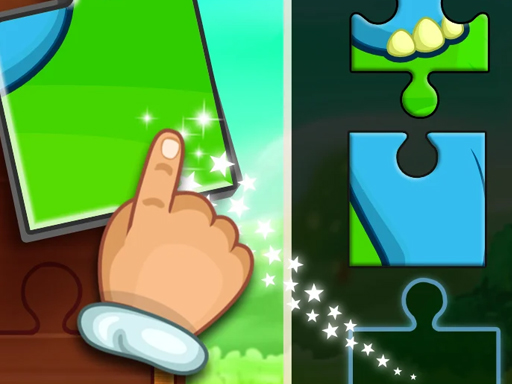
What Players Actually Do
Each session starts on a selection screen where a child picks a picture to assemble. The board shows empty outlines, and the pieces sit nearby. A player drags any piece toward its matching spot. When the piece lands correctly, it locks in with a pleasant sound. That audio cue is the main feedback loop: it confirms success without needing words, scores, or a timer. A hint button is available when a child gets stuck, showing where a piece belongs. Because nothing counts down, the pace is entirely self-directed.
Designed for Pre-Readers
The interface avoids text-based instructions. A preschooler who cannot read can still navigate the selection screen, recognize the puzzle shapes, and understand the drag-and-drop action by watching the pieces respond. Large piece sizes reduce the fine-motor precision required, which matters for younger children whose hand control is still developing. The game is described as age-appropriate and tested for preschoolers, and it contains no personal data collection.
Progression and Themes
Completing a puzzle unlocks new ones, giving the game a gentle forward pull without pressure. Multiple themes, including animals and nature scenes, vary the visuals so the experience does not feel identical from one puzzle to the next. There is no penalty for taking a long time, and no score to beat, so the reward is simply the finished picture and the unlocking of the next option.
Why the Ad-Free Choice Matters
The game is completely ad-free. For a preschool audience, that removes the risk of a child tapping an unintended ad or being interrupted mid-puzzle. Combined with the absence of data collection and the lack of scores or timers, the design keeps the focus on the puzzle itself rather than on retention mechanics.
Comments
0 comments